The automotive industry is undergoing one of the most significant transformations in its history. With the gradual rollout of autonomous driving technologies—especially Level 3, Level 4, and Level 5 systems—the very meaning of “driving” is being redefined. Instead of actively controlling a vehicle, passengers may soon transition into being passengers full-time, turning previously demanding driving hours into flexible, usable free time.
This shift doesn’t just affect transportation—it fundamentally changes how car interiors are designed, experienced, and used. The cabin of the future will likely resemble a hybrid between a living room, office, and entertainment hub rather than a traditional driver-focused cockpit.
In this article, we explore how autonomous driving could reshape interior vehicle usage, human behavior, and digital lifestyles in a world where cars no longer require human control.
Understanding Autonomous Driving Levels 3 to 5
To understand how car interiors will change, it’s important to distinguish between the higher levels of driving automation.
Level 3: Conditional Automation
At Level 3 autonomy, the vehicle can handle most driving tasks under specific conditions, but the human driver must be ready to take control when requested. This creates a transitional phase where the interior still needs to support driving but also allows moments of disengagement.
In practice, drivers might watch videos, check emails, or relax—but must remain alert.
Level 4: High Automation
Level 4 vehicles can operate independently within defined environments (such as cities or highways). Human intervention is not required in most scenarios.
This unlocks true “hands-free” travel experiences, allowing passengers to treat the car as a mobile lounge or workspace.
Level 5: Full Automation
Level 5 represents complete autonomy. There is no steering wheel, no pedals, and no expectation of human control.
At this stage, the car interior becomes entirely purpose-driven for passengers, similar to a self-driving room on wheels.
The Death of the Traditional Driver-Centric Cabin
For over a century, car interiors have revolved around one central concept: the driver. Steering wheels, dashboards, mirrors, and pedals define the spatial logic of every vehicle.
With full autonomy, this layout becomes obsolete.
Key Interior Changes:
- Removal of steering wheel and pedals
- Rotating or reclining seats
- Expanded cabin space due to optimized layouts
- Reconfigurable interior modules
- Hidden or retractable control systems for emergencies
This shift allows designers to rethink the car as a flexible environment rather than a mechanical control station.
The Rise of the Mobile Living Room
As driving becomes automated, car interiors are evolving into “third spaces”—environments that are neither home nor office, but something in between.
Comfort Over Control
Seats will likely become more like lounge chairs, with:
- Full recline functionality
- Adjustable lighting and climate zones
- Massage and relaxation systems
- Soundproofed interiors for privacy
Passengers will prioritize comfort over control, especially on long commutes or travel routes.
Social Interaction Spaces
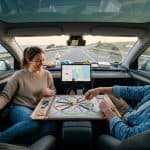
Families and groups could face each other instead of sitting in a forward-facing arrangement. This transforms the car into a social environment where conversations, games, and shared media become central activities.
Work on the Move: The Mobile Office Revolution
One of the most impactful changes autonomous driving brings is the ability to reclaim commute time for productivity.
Fully Functional Workstations
Future vehicles may include:
- Fold-out desks
- High-speed connectivity (5G/6G and beyond)
- Video conferencing setups
- Augmented reality displays for multitasking
Commuters could effectively gain hours of productive time every week, turning travel into an extension of the office.
Hybrid Work Culture Integration
As remote and hybrid work models expand globally, autonomous vehicles could become essential productivity hubs, bridging the gap between home and workplace environments.
Entertainment Becomes Central to the Experience
When users no longer need to focus on driving, entertainment becomes a dominant feature of car interiors.
Immersive Media Systems
Expect to see:
- Ultra-wide wraparound screens
- 360-degree audio systems
- Virtual reality and augmented reality integration
- Personalized content streaming
The cabin may feel like a private cinema or gaming room.
However, with increased connectivity and screen time, content consumption habits will also diversify dramatically. Users may browse social media or stream film porno hd, which reflects how broad and uncontrolled internet usage can become when attention is fully freed from driving responsibilities.
This raises new questions about digital wellbeing and content moderation inside private autonomous spaces.
Mental Space: How Freedom Changes Attention
Without the need to focus on driving, passengers experience a significant shift in cognitive load.
From High Alert to Passive Engagement
Driving demands constant attention, but autonomous systems remove this requirement. This creates:
- Reduced stress during travel
- Increased mental downtime
- Greater susceptibility to boredom or overstimulation
Designers will need to balance stimulation and relaxation carefully to avoid cognitive overload or disengagement.
The Risk of Over-Consumption
When time becomes abundant, digital consumption tends to increase. This includes entertainment, gaming, social media, and unrestricted browsing. Without thoughtful design, passengers may become overly dependent on screens to fill the gap once occupied by driving attention.
Interior Flexibility: Modular Design Becomes Standard
Future autonomous vehicles will likely prioritize adaptability.
Transformable Cabin Layouts
A single vehicle may support multiple configurations:
- Office mode
- Relaxation mode
- Social mode
- Sleep mode
- Entertainment mode
Seats could rotate, tables could expand, and lighting could adjust dynamically depending on the selected environment.
Smart AI Personalization
Artificial intelligence systems will learn user preferences and automatically adjust the interior. For example:
- Morning commute: productivity setup
- Evening ride: relaxation lighting and music
- Weekend travel: entertainment or social configuration
Safety, Trust, and Psychological Adaptation
Even as autonomy increases, trust remains a critical factor.
Letting Go of Control
Many passengers may initially struggle with the idea of not controlling the vehicle. This psychological shift is as important as the technical one.
Manufacturers will need to design interiors that:
- Communicate safety clearly
- Provide reassurance through visual feedback
- Offer optional manual override systems
Transparency in Automation
Users will likely demand real-time information about what the vehicle is doing, including route decisions, obstacle detection, and system status.
Augmented Reality and the Future of Windows
Car windows may no longer be just transparent glass.
AR-Enhanced Travel Experience
With augmented reality overlays, passengers could see:
- Landmark information
- Navigation data
- Interactive entertainment elements
- Real-time translation of surroundings
The physical world and digital world will merge seamlessly inside the vehicle environment.
Sleep, Relaxation, and Long-Distance Travel
One of the most transformative impacts of autonomous driving is the ability to sleep safely during travel.
Rest-Oriented Interior Design
Future cabins may include:
- Fully flat sleeping surfaces
- Temperature-controlled bedding systems
- Noise-canceling environments
- Circadian rhythm lighting
Long-distance travel could become far less exhausting, effectively turning cars into mobile sleep pods.
Ethical and Digital Wellbeing Considerations
With increased freedom comes responsibility.
Managing Screen Time
As passengers gain uninterrupted access to digital platforms, concerns arise about excessive consumption of online content, including streaming services, gaming, and other media.
Even casual browsing patterns—such as watching videos, browsing social platforms, or encountering search behaviors like film porno hd—highlight the need for optional content filtering systems in shared or family vehicles.
Family-Friendly Controls
Car manufacturers may introduce:
- User profiles with parental controls
- Content restriction systems
- Safe browsing modes for minors
- Time-based app limits during travel
These features will help ensure autonomous vehicles remain safe and inclusive environments.
The Car as a Personal Ecosystem
Ultimately, autonomous driving transforms the car into more than a vehicle—it becomes a personal ecosystem.
Integrated Digital Life
Your car will likely sync with:
- Smart homes
- Wearable devices
- Work calendars
- Entertainment subscriptions
This creates continuity between spaces, allowing users to move seamlessly between environments without disruption.
Economic and Urban Impacts
The shift toward autonomous interiors will also reshape broader society.
Reduced Need for Parking Space
If cars can operate independently, they may not need to stay parked for long periods, reducing urban parking demand.
Shared Autonomous Fleets
Ride-sharing services could dominate, offering customizable interiors depending on passenger needs at the time of booking.
A New Definition of Travel
Autonomous driving is not just an automotive upgrade—it is a redefinition of mobility itself. As we move from Level 3 to Level 5 autonomy, the concept of “driving” will fade into history, replaced by the idea of “travel experience design.”
Car interiors will evolve into multifunctional environments that support work, rest, entertainment, and social interaction. Freed from the constraints of manual driving, passengers will gain unprecedented control over how they use their time on the road.
However, this freedom also introduces new challenges—particularly around attention, digital wellbeing, and content consumption habits. The future car will need to balance openness with responsibility, ensuring that the expanded freedom of autonomous travel enhances life rather than overwhelms it.
In the end, the autonomous car interior will reflect a broader truth about technology: when machines take over responsibility, humans gain time—but must also learn how to use it wisely.